miércoles, 2 de junio de 2010

Children learn what they live

If children live with criticism, they learn to condemn.

If children live with hostility, they learn to fight.

If children live with fear, they learn to be apprehensive.

If children live with pity, they learn to feel sorry for themselves.

If children live with ridicule, they learn to feel shy.

If children live with jealousy, they learn to feel envy.

If children live with shame, they learn to feel guilty.

If children live with encouragement, they learn confidence.

If children live with tolerance, they learn patience.

If children live with praise, they learn appreciation.

If children live with acceptance, they learn to love.

If children live with approval, they learn to like themselves.

If children live with recognition, they learn it is good to have a goal.

If children live with sharing, they learn generosity.

If children live with honesty, they learn truthfulness.

If children live with fairness, they learn justice.

If children live with kindness and consideration, they learn respect.

If children live with security, they learn to have faith in themselves and in those about them.

If children live with friendliness, they learn the world is a nice place in which to live.

Homophobic Bullying


Homophobic Bullying


INDEX
............................................................................................
What is the bullying? ....................................................

What can we do about bullying situations? ......................

Where does the homophobic bullying take place?

Status of LGBT youth in schools

Tutoring Project


What is the bullying?
Bullying is harassment that is characterized as SECRET, which involves a MORAL DESTRUCTION, NOT LET OUTPUTS to the person who suffers it.
We can say that all bullyings have a homophobic element, since homosexuality is used as an instrument to attack the victims of bullying (words like sissy, fag, pussy, used to chide the victim of bullying in an indiscriminate way and no matter what sexual orientation of the individual. Therefore, it is used by the negative charge of the word.) Homophobic harassment, is characterized by more secret than the rest of the bullyings. That is, the person suffering homophobic bullying for being LGBT(acronym referring collectively to lesbian, gay, bisexual and transgender people), he/she save the secret bullying situation, since you can not talk about their orientation and / or sexual identity openly with other people (relatives, friends, teachers, etc..) regarding the lack of positive about homosexuality, myths, prejudices and other situations. Therefore, the pupil to become an LGBT harassed person, invisible in the classroom. Such harassment is a situation of moral destruction: people that are internalized different, that are not valid, they have feeling of inferiority. Bullying does not exits, the person who suffers is caught in a difficult situation without support. One of the biggest problems when it comes to homophobic bullying is invisibility of the problem: educators, teachers, etc, are incapable of seeing the situation precisely because of the secrecy property. In many cases, the harassment of LGBT people are also LGBT, but not have recognized or accepted their homosexuality or bisexuality, and thus attack and vent their ire against the rest of LGBT people.

What can we do about bullying situations?
Many times is very difficult to identify the victim and the aggressor. Bullying is harassment of one or more persons to another person identified. It supposed sustained pain that remains permanently in time. Therefore when you talk about bullying are not talking about an isolated case, but harassment is maintained and extended in time and that is growing exponentially. The bullying can suffer effects such as: the person starts to bother class or to stop going to school, etc.
We find two types of attitudes to bullying situations: assets and liabilities. The person who is active in a situation of harassment is one that involved, and therefore their attitude can either help the offender or the victim. He/She can stand up for the person suffering the bullying or otherwise may be added to assailant and rebuke the person. The person who decides to remain passive in situations of bullying only "help" the aggressor. Therefore, as educators we are educating and working with viewer to intervene with bullying situations, and make him understand that at one point his figure can help minimize and reduce situations harassment, assault, contempt, etc. Almost always the victims of bullying are people who stand out for some reason relative to other peers. (They're LGBT, race, intellectual level physical appearance). these features are used by attackers to abuse and harassment of victims of bullying.

The offender is usually an insecure person of itself. One of the key issues work with offenders is that of empathy with the victim while we use assertiveness work.


Where does the homophobic bullying take place?
The homophobic bullying occurs mostly in public places. This means that in most cases perpetrators are not punished, homophobic bullying is characterized by impunity and partners of the victims / aggressors are passive in these situations therefore help the aggressor, and harassed person is kept secret. Today new technologies are new means by which we practice homophobic bullying. According to research conducted by the Catalan Institute study of violence:
1. The victims of homophobic bullying have a high sense of loneliness.
2. The attacks are unpunished in public places.
3. Faced with situations of bullying does not take into account the homophobic.
4. Bullying vs messenger. (The bullying through social networks or messenger.)
5. LGBT person invisible to the bullying.
Status of LGBT youth in schools:
- Sexuality is addressed within the institutes from a heterosexual perspective.
- The family exemplaries that are shown inside the high schools are the ones of traditional families. (family consisting of married heterosexual parents and sons / daughters.)
- LGBT people are invisible in schools, and therefore teachers "did not perceive" the reality or the need for diversity work emotional and sexual. Note that, in schools (as in the rest of the society) is given universal assumption of heterosexuality.
- LGBT People are afraid of being stigmatized, isolated by their own peers, as well as by the team of teachers.
- Lack of awareness and ignorance on the part of teachers and to address affective and sexual diversity in the classroom.
- High stigmatization of people who adopt gender roles associated with other sex (transsexual or transgender people).
- Inside the school we found that homophobia and sexism are like two sides of the same coin.
Tutoring Project.
Schools are a reflection of discrimination and homophobia existing in society. In this situation LGBT youth encounter:
- Lack of family support.
- Isolation and victimization.
- Inhibition of teachers.
It is important that LGBT young people feel loved and information centers educational reference. To address the issue prominently LGBT center in some IES in Spain where carries out the theme of mentoring LGBT annually promoted initiatives such as LGBT Cultural Day which aims to:
1. poetry.
2. Music.
3. conferences.
4. Exhibitions
5. So on.
This type of meeting is open to the collaboration of all those who so desire, regardless of sexual orientation and identity.
The LGBT mentoring project is a program of support and guidance to young LGBT for self-esteem, get advice, find positive references answer your questions about homosexuality, bisexuality or transsexuality. This type of service is completely confidential, which ensures that thing and youth LGBT can find a safe space.

miércoles, 28 de abril de 2010

Ejercicio Práctico

PRÁCTICA: “CASO BULLYING”

Protocolo de actuación:

Esta mañana, Penélope de 14 años, ha llegado tarde a clase como casi siempre; la noche anterior se acostó tarde
esperando a su madre que llegó borracha. Ha entrado en el aula y no ha dado ni los buenos días, antes de sentarse
ya le ha dado una colleja a Víctor. Víctor tiene 13 años, es un chico normal, algo reservado; no tiene muchos
amigos porque ha llegado nuevo al centro.
Penélope, que se sienta detrás de Víctor, se ha pasado toda la clase molestándole e insultándole. Mientras, Don
Vicente sigue su explicación y aunque en ocasiones llama la atención a Penélope, ella nunca le hace caso.
Al acabar la clase Don Vicente ha salido del aula, entonces Penélope más poderosa, y con el respaldo de algunos
de sus compañeros/as, empieza a meterse con Víctor, como cada día. Víctor no se defiende, hace como si no la
escuchara, su compañero de mesa, Miguel, intenta que le dejen en paz.
Entonces Víctor se levanta como para salir de clase y en ese momento Penélope le empuja y cae dándose un
fuerte golpe en cabeza con el borde de la silla. Entra Don Vicente que ha escuchado escándalo, todos se sientan.
Mientras, Víctor se levanta aturdido, Don Vicente le pregunta que qué ha pasado, él contesta que nada, que se ha
tropezado, el profesor le pregunta a Miguel, éste dice que no sabe, que estaba jugando al ordenador, después,
pregunta a Penélope y ella muy enfadada y nerviosa dice que por qué siempre le acusan, que Víctor se ha caído.
Pregunta a la clase si alguien ha visto lo que ha pasado y todos quedan en silencio. Don Vicente vuelve a
preocuparse por el estado de Víctor y al observar que está mejor se va tranquilo.

1. Enumera del 1 al 5 a los personajes del suceso, ordenándolos del que tiene mayor grado de
responsabilidad (1) al que tiene menos (5).

1 ---------- 2------------- 3------------- 4 --------------5


2. Identifica a los personajes uniendo a cada uno con su rol en el suceso narrado.


Personajes---------------- Roles

Don vicente ----------------Variable externa
Víctor ----------------------Agresor
Penélope -------------------Espectador implicado pasivo
Madre ---------------------Víctima
Miguel ---------------------Espectador pasivo

martes, 27 de abril de 2010

Acoso Escolar: ``Bullying´´


Definición:


“Un gesto, un golpe, un insulto, hacer oídos sordos, menospreciar, amenazar, ridiculizar, marginar… en una
palabra: excluir; todo esto son manifestaciones de la violencia en la escuela que afectan a cada niña y a cada niño:
a su cuerpo, a su forma de entender el mundo, a su sexualidad, a la visión que tienen de sí mismas/os, a su
dignidad,…”


Características del Bullying:

Hay una serie de aspectos que caracterizan al bullying y que han venido señalándose a lo largo del tiempo:
- Debe existir una víctima (indefensa) atacada por un abusón a grupo de matones.
- Debe existir una desigualdad de poder o “desequilibrio de fuerzas” entre el más fuerte y el más débil.
- La acción tiene que ser repetida. Tiene que suceder durante un periodo largo de tiempo y de forma recurrente.
- La agresión supone un dolor no sólo en el momento del ataque, sino de forma sostenida, ya que crea la
expectativa en la víctima de poder ser blanco de futuros ataques.
- No hay provocación previa por parte de la víctima.
- Existe intencionalidad por parte del agresor o agresores.
- Es un tipo de violencia difícil de identificar, que se manifiesta bajo la superficie de las relaciones observables en la
escuela. Oculta casi siempre para los adultos, pero bien conocida para el alumnado.
- La agresión puede ser física, verbal o relacional-psicológica.
- Es más frecuente en edades comprendidas entre los 11 y los 15 años.


¿Entre qué personas se pueden dar situaciones de violencia en el centro?

- Alumno/a - Profesor/a
- Alumno/a - Alumno/a
- Profesor/a - Alumno/a


Causas:


- La sociedad.
- Los medios de comunicación social.
- La organización del centro educativo.
- El estilo del profesor en el proceso de enseñanza – aprendizaje.
- La relación entre iguales.
- Factores familiares.
- Factores personales


Tipos de Bullying:


- Físico: empujones, patadas, puñetazos, agresiones con objetos. Este tipo de maltrato se da con más frecuencia
en las escuelas de Primaria. Esconder, robar, romper pertenencias serían ejemplos de maltrato físico indirecto.
- Verbal: insultos y motes principalmente, también menos aprecios en público. Últimamente el teléfono móvil e
Internet se están convirtiendo en vías para este tipo de maltrato, que es el más habitual. De forma indirecta sería
hablar mal de alguien, hacer falsos rumores, etc.
- Social: pretenden ubicar aisladamente al individuo respeto al grupo en un mal status y hacer partícipe a otros
individuos, en ocasiones, de esta acción. Estas acciones se consideran bullying indirecto. Así como tratar como un
objeto.
- Psicológico: son acciones encaminadas a minar la autoestima del individuo y fomentar su sensación de
inseguridad y temor. El componente psicológico está en todas las formas de maltrato.


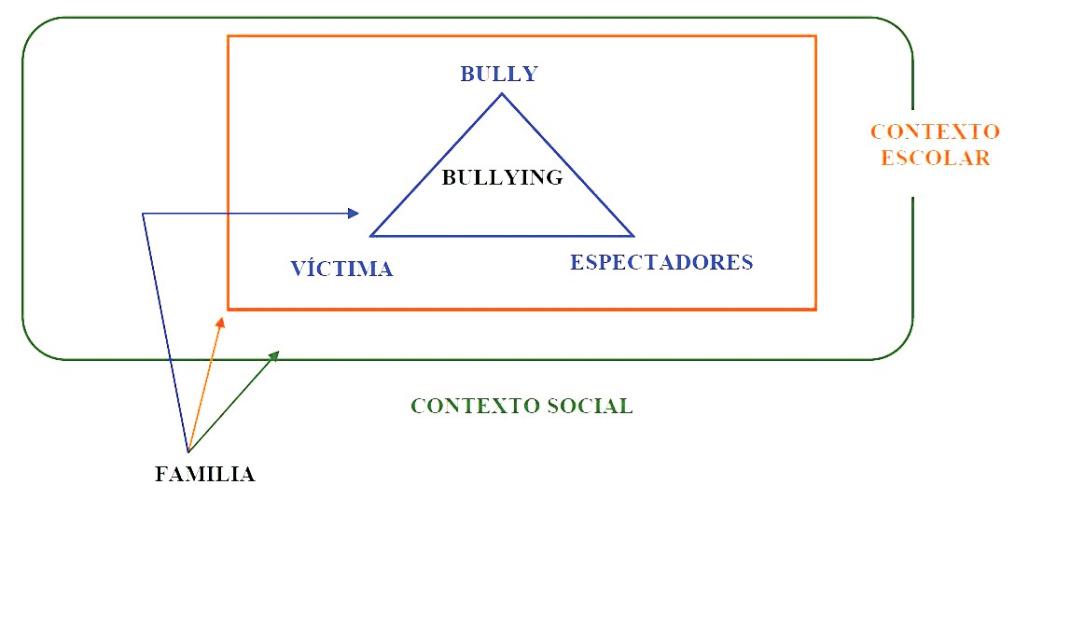
Implicados:


Intervención:

- Prevención: desde el centro (fomentar el trabajo en grupos cooperativos) y desde el entorno familiar (dar
modelos positivos; mantener unas buenas relaciones familiares. No aceptar la violencia. Resolver amigablemente
los conflictos.
- Planificación: Para planificar un proyecto antibullying tenemos que partir del esfuerzo, coordinación e
implicación de todos los miembros de la comunidad educativa (de dónde partimos, qué nos proponemos, cómo
pensamos llevar a la práctica el proyecto, lo llevamos a la práctica y hasta que punto lo vamos consiguiendo).
- Intervención: debemos considerar todas aquellas actuaciones que desde diferentes puntos de vista y niveles de influencia pueden prevenir, evitar o erradicar el bullying.
- Nivel primario: Prevenir
- Nivel secundario: Intervenir en los casos
- Nivel Terciario: Evitar la recurrencia de la conducta violenta, estabilizándola o intentando suprimirla.


Protocolo de actuación:

Paso 1. Identificación, comunicación y denuncia de la situación.
Paso 2. Actuaciones inmediatas.
Paso 3. Medidas de urgencia.
Paso 4. Traslado a la familia.
Paso 5. Traslado al resto de profesionales que atienden al alumno o alumna acosado.
Paso 6. Recogida de información de distintas fuentes.
Paso 7. Aplicación de medidas disciplinarias.
Paso 8. Comunicación a la Comisión de Convivencia.
Paso 9. Comunicación a la Inspección Educativa.
Paso 10. Elaboración de un Plan de Actuación por parte de la Dirección.
Paso 11. Comunicación a las familias.
Paso 12. Seguimiento del Plan de Actuación por parte de la Inspección Educativa.
Paso 13. Asesoramiento del Gabinete Provincial de Asesoramiento sobre la Convivencia Escolar.